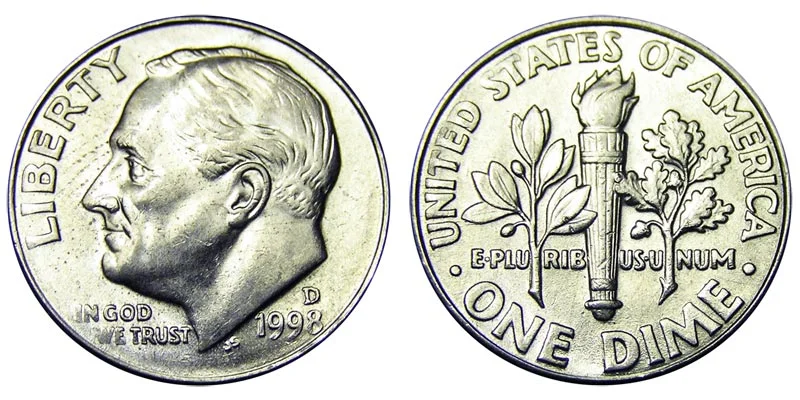
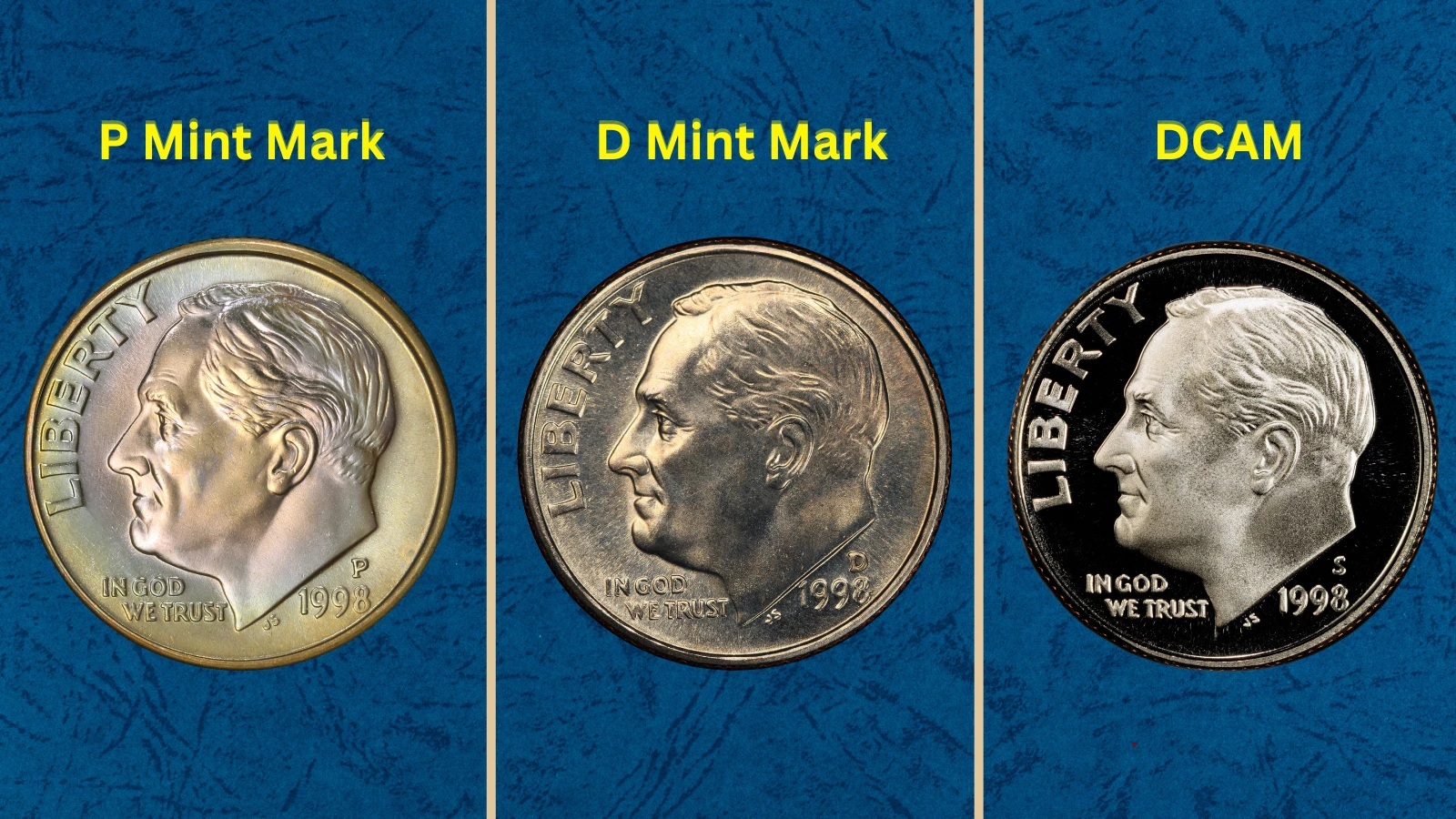
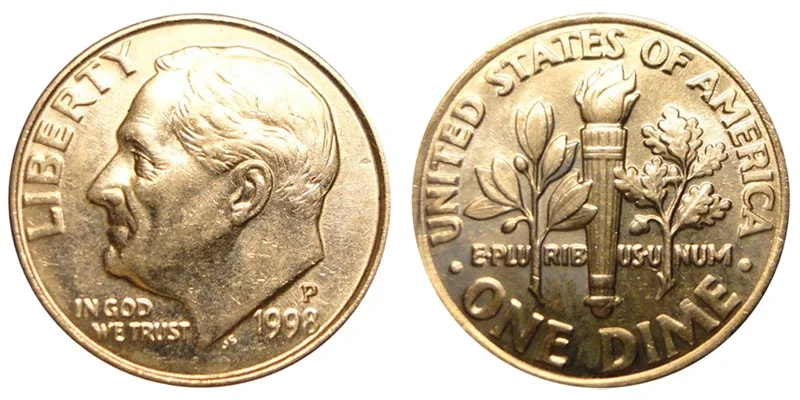
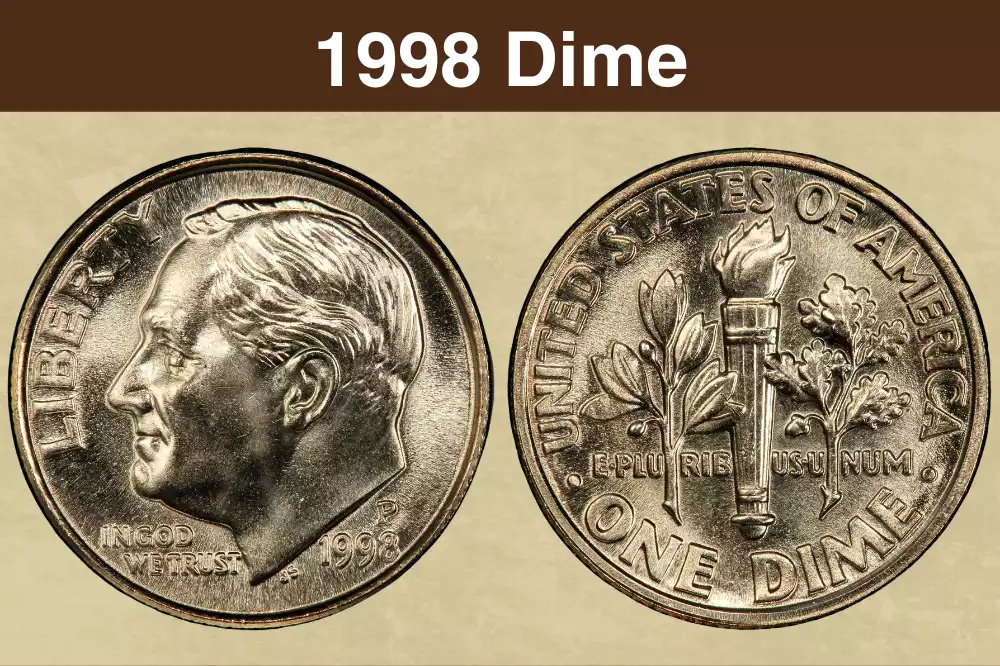
A 1998-D Roosevelt dime graded PCGS MS62 with Full Bands sold for $4,602 at Heritage Auctions — extraordinary for a coin most people spend without thinking. Most 1998 dimes circulate at face value, but knowing what to look for on the torch can change everything.
The Full Bands designation is the single most important value factor for 1998 business strikes. Use this checker before you spend that coin or toss it in a jar.
The torch bands are merged, mushy, or show no clear separation between the upper and lower pairs. This describes the vast majority of 1998-D business strikes due to the Denver Mint's notoriously poor striking pressure that year. Value: $0.10 to a few dollars at most.
Both pairs of horizontal bands on the torch show complete, unbroken separation with a clean channel between them. No marks or breaks cross the bands. PCGS has certified fewer than a handful at MS68 FB. Even a low-grade MS62 FB sold for $4,602 at Heritage Auctions in January 2012.
Check all that apply to your 1998 dime:
Not sure where to start? Describe what you see and our analyzer will interpret your coin's features and give you a tailored assessment.
Want a number, not just a description?
Use the step-by-step calculator to get a specific value estimate for your 1998 dime.Answer 3 quick questions to get your instant value estimate.
If you're not yet sure about your coin's condition or what Full Bands means, there's a free 1998 Dime Coin Value Checker tool that lets you upload a photo of your coin for an AI-assisted identification before you run the numbers above.
Jump to any section of this guide
The 1998 Roosevelt dime series lacks named doubled-die varieties — the U.S. Mint's transition to single-squeeze hubbing largely eliminated them by this era. What 1998 dimes do offer are genuine, certified mint production errors with confirmed auction records. Here are the most significant varieties to search for, ranked by collector demand and documented sale prices.
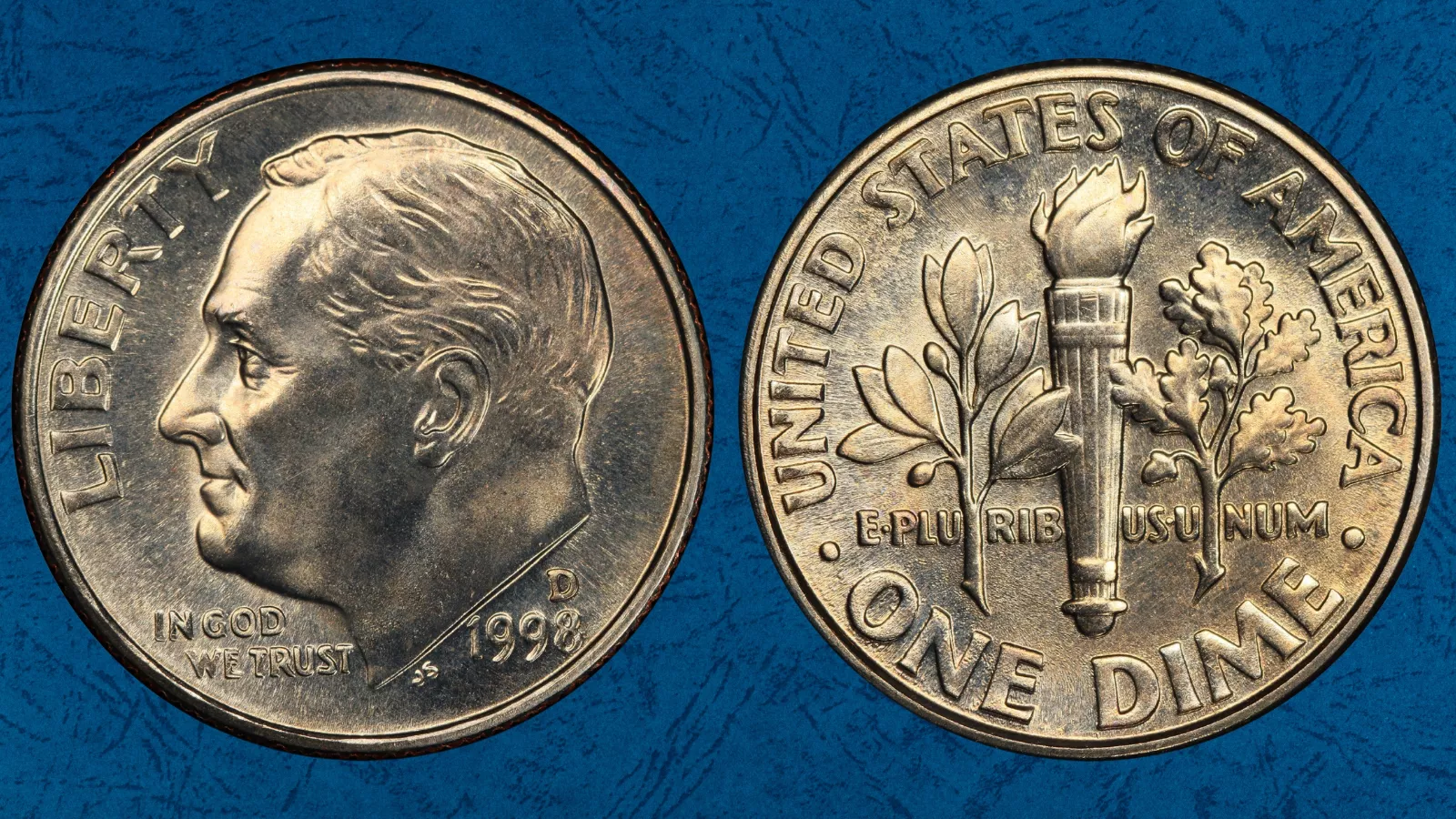
The Full Bands designation on the 1998-D Roosevelt dime represents one of the most extreme condition rarities in the entire modern clad series. The Denver Mint's 1998 production run was characterized by notoriously weak striking pressure, resulting in virtually no coins achieving complete torch band separation under PCGS's exacting Full Bands standards.
To qualify for PCGS Full Bands, a coin must grade MS60 or better and show complete separation of both pairs of horizontal bands on the torch's reverse, with no significant cuts or marks crossing those bands. For 1998-D, this standard was almost impossible to meet straight from the mint machinery, creating a paradox where a coin with a mintage of over 1.17 billion is genuinely rare in this one specific respect.
The market has confirmed this rarity dramatically: a 1998-D PCGS MS62 Full Bands specimen sold for $4,602 at Heritage Auctions in January 2012. This price for a coin technically below gem grade — MS62 is barely uncirculated — demonstrates how the FB designation transforms value. PCGS reports only three known examples at MS68 FB, meaning higher-grade specimens would almost certainly exceed this record substantially if they appeared at auction.
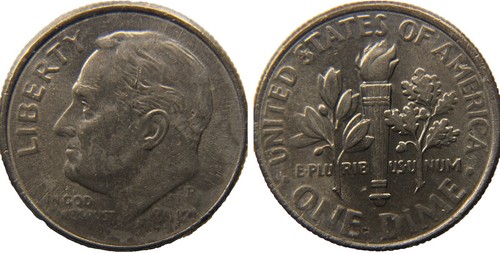
The most celebrated and valuable 1998 mint error is a Philadelphia-issue Roosevelt dime struck on a Lincoln cent planchet. This off-metal error occurs when a copper cent blank accidentally finds its way into the dime-striking press, where it receives the full Roosevelt dime die impression. The resulting coin is a genuine hybrid — it carries the dime's design but on completely the wrong metal and size.
Visually, the error is unmistakable to anyone who knows what to look for. The coin appears distinctly copper-red rather than the silver-and-copper clad of a normal dime. It is also physically smaller in diameter than a standard dime, causing the outer portions of the design — particularly the lettering around the rim — to be cut off at the edges where the cent planchet is narrower than the dime die. The coin is also lighter in weight than a standard dime (weighing approximately the same as a cent, about 2.5 grams, rather than 2.27 grams for a clad dime).
A certified example graded PCGS MS-66 Red sold for $3,360 at Heritage Auctions in September 2024, confirming sustained collector demand for this dramatic error. The "Red" designation indicates the coin retains its original copper-red luster with minimal oxidation, maximizing its appeal to error coin collectors. Wrong planchet errors of any type are exceptionally rare in modern coinage, as Mint production controls are designed to prevent exactly this kind of mix-up.
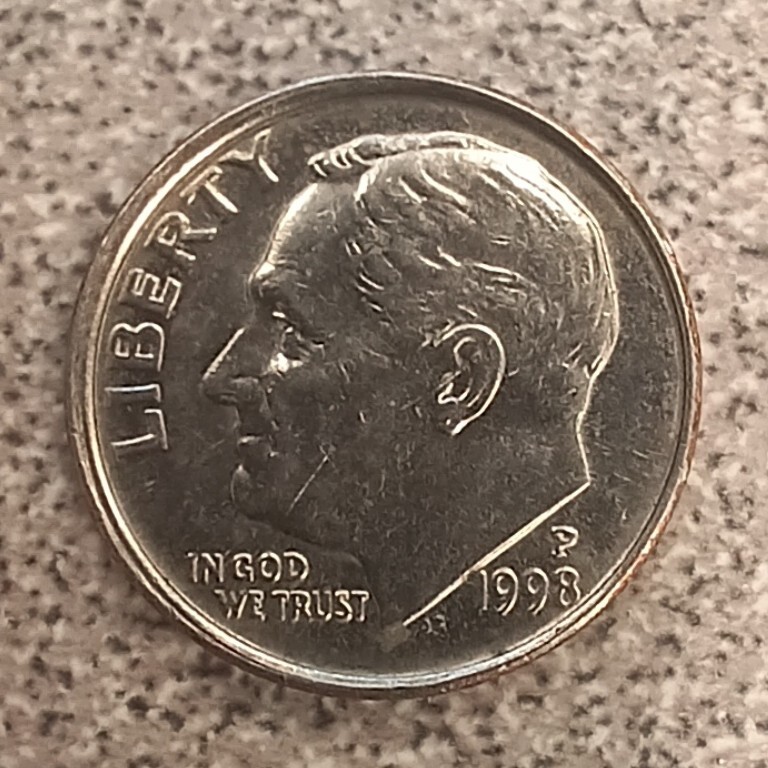
Off-center strikes happen when the planchet is not properly seated within the retaining collar at the moment of striking. The die comes down on only a portion of the planchet's surface, stamping the design onto one section while leaving the rest as an unstruck blank crescent. The result is a dramatically lopsided coin that immediately catches the eye of any collector or even a casual observer.
For 1998 Roosevelt dimes, off-center strikes are the most frequently encountered certified errors. The numismatic premium scales directly with the degree of displacement — a 10–20% off-center piece fetches $20–$35 in uncertified condition, while a dramatic 50–70% off-center strike in MS64 condition has sold for approximately $175. Collectors specifically prize examples that, despite being significantly off-center, still retain the full date "1998" readable somewhere on the coin — a date-visible off-center commands a notable premium over dateless examples.
A 70% off-center 1998 dime strike graded MS64 by ANACS has been documented, representing the more dramatic end of this error class. The raking, angled appearance of these coins makes them compelling display pieces, and they attract both error coin specialists and general collectors looking for eye-catching modern anomalies. Any off-center exceeding 40% displacement with a visible date is worth having certified by PCGS or NGC.
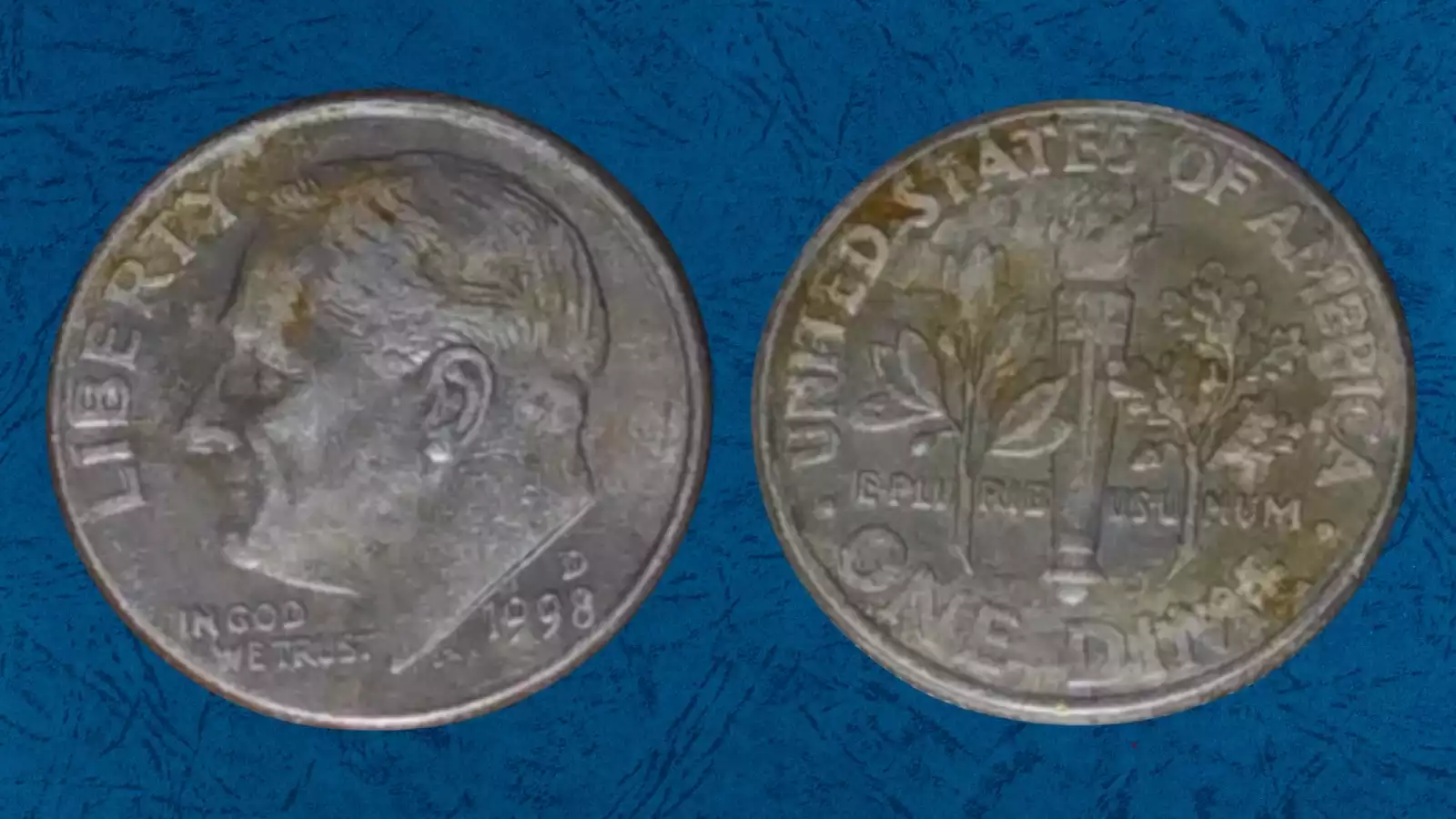
Modern clad coins like the Roosevelt dime are manufactured by bonding cupronickel outer layers to a pure copper core. A missing clad layer error occurs when one of these outer layers fails to bond to or is absent from the planchet before striking. The die then stamps the design directly onto the bare copper core, resulting in a coin with one normal-looking silver-colored side and one distinctly copper-colored side that is visually identical to a cent's surface.
For the 1998 issue, both a Philadelphia and a Denver missing obverse clad layer example have been certified and sold at auction. The 1998-P example was graded AU58 at Heritage Auctions, where it was verified by weighing — at approximately 1.86 grams rather than the standard 2.27 grams for a full clad dime, the missing layer accounts for the significant weight reduction. The 1998-D version was also graded PCGS AU58 and sold at GreatCollections, confirming that this error occurred at both minting facilities that year.
Because both pieces graded AU58, they show minor evidence of handling or circulation, which is typical — missing clad layer errors are often not noticed at first glance and enter circulation before a collector pulls them. An uncirculated missing clad layer example would command a meaningful premium above these circulated sales prices. The dramatic visual contrast between the copper-colored affected face and the normal silver-toned reverse makes these coins striking conversation pieces and in-demand additions to error coin collections.
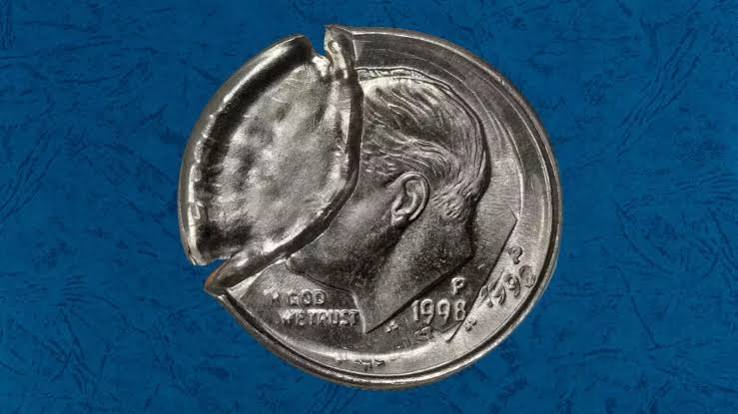
A double-struck indent error is among the most visually dramatic and mechanically complex errors that can emerge from a modern mint press. It occurs in two stages: first, a planchet is struck normally to create a coin; then, before ejecting from the press, a second planchet falls on top of or alongside the first, and the die strikes again — this time striking both coins simultaneously. The upper coin receives a normal impression while the lower coin receives an indented impression from the edge of the upper coin pressing into it.
On a 1998 Roosevelt dime with this error, you will see two overlapping impressions of the design — one clear and complete, and a second impression either offset or incused into the coin's surface, creating a raised-rim indentation where the second planchet's edge pushed down. These errors require very specific conditions: the press must not eject the coin between strikes, and a second planchet must enter the collar. The result is a coin that looks like it was struck by two different dies in rapid succession.
A 1998 Roosevelt dime with a double-struck obverse indent error has been certified by NGC at the high grade of MS67 FB, indicating the coin not only survived this unusual minting accident in essentially perfect condition, but also achieved Full Bands designation on the torch — making it doubly notable. The MS67 FB certification substantially increases its value over a similar error in lower grades. These coins attract both error coin specialists and registry set collectors seeking unusual certifications.
Found one of these errors on your coin?
Run it through the calculator to get a value estimate — select the error type in Step 3.Values below reflect current market data from PCGS, NGC, and recent auction results. For a thorough step-by-step 1998 dime identification walkthrough with grading photos, cross-reference your coin before drawing final conclusions. The Full Bands row (highlighted in gold) represents the most critical value driver for this date.
| Variety | Worn / Circulated | Uncirculated (MS60–65) | Gem (MS66–MS68) | Rarity |
|---|---|---|---|---|
| 1998-P (Regular) | $0.10 – $0.35 | $3 – $12 | $12 – $65 | Common |
| 1998-D (Regular) | $0.10 – $0.35 | $3 – $12 | $65 – $275 | Common |
| 1998-P Full Bands (FB) | — | $8 – $50 | $115 – $895+ | Valuable |
| 1998-D Full Bands (FB) | — | $4,602+ | $4,602++ | Extremely Rare |
| 1998-S Clad Proof DCAM | — | — | $3 – $18 | Modest |
| 1998-S Silver Proof DCAM | — | — | $6 – $55 | Modest |
| Off-Center Error (40–70%) | $20 – $35 | $50 – $100 | $100 – $175+ | Valuable |
| Wrong Planchet Error | $500+ | $1,500+ | $3,360+ | Rare |
★ Gold row = signature variety (1998-D Full Bands). Red row = rarest error (1998-D FB confirmed record). 1998-D FB MS62 Heritage Auctions 2012 = $4,602.
🪙 CoinKnow lets you photograph your 1998 dime and get an instant value estimate based on the visible strike quality and condition — a coin identifier and value app.
The 1998 production run was one of the highest-volume years in Roosevelt dime history, yet certain specimens are extraordinarily scarce in high grades — a paradox that defines modern numismatics.
| Mint / Type | Mint Mark | Mintage | Composition | Notes |
|---|---|---|---|---|
| Philadelphia Business Strike | P | 1,163,000,000 | 75% Cu / 25% Ni clad | Circulation; slightly fewer FB survivors than listed |
| Denver Business Strike | D | 1,172,250,000 | 75% Cu / 25% Ni clad | Weakest strike quality; extremely rare FB specimens |
| San Francisco Clad Proof | S | 2,086,507 | 75% Cu / 25% Ni clad | Sold in annual proof sets; all DCAM quality |
| San Francisco Silver Proof | S | 878,792 | 90% Ag / 10% Cu | Sold in silver proof sets; contains 0.0723 oz Ag |
| Total 1998 Production | — | 2,337,315,299 | — | All mints combined |
Grading a 1998 Roosevelt dime requires evaluating two independent factors: overall surface preservation and strike quality on the torch. A weakly struck coin can grade MS67 but still fail to earn Full Bands — these are separate assessments.
High points show obvious flattening. Roosevelt's cheek, the area above the ear, and the hair details above the forehead are smooth or flat. The torch flame and bands show little definition. Most circulating 1998 dimes fall into this category. Value: face value to $0.35.
Light wear only on the very highest points — cheek and hair above ear show slight smoothing. Luster partially intact in protected areas like between hair strands. Under AU-58, barely perceptible wear with most luster remaining. Still not worth much above face value unless an error coin. Value: $0.20 to $1.
No wear whatsoever — full original mint luster visible at all points. Contact marks (bag marks) and minor surface distractions separate MS60 from MS65. At MS65 Gem, the coin shows strong luster and only a few tiny contact marks barely visible without magnification. Check the torch bands carefully at this grade level. Value: $3–$12 for regular; more for Full Bands.
Exceptional luster, minimal contact marks, and strong eye appeal. At MS67 and above, surfaces approach perfection. The 1998-D is a conditional rarity above MS67 due to weak strikes — only a handful of PCGS-certified examples exist at MS68. Full Bands on a Gem coin dramatically increases value. Value: $65–$275 regular; $895–$4,602+ with Full Bands.
📱 CoinKnow can help you compare your coin's surface to graded reference examples and cross-check your condition assessment — a coin identifier and value app.
The right venue depends heavily on what you have. A Full Bands specimen belongs at auction. A common uncirculated example sells quickly on eBay or to a local dealer.
The single best venue for 1998-D Full Bands examples and confirmed major errors. Heritage set the $4,602 record for the 1998-D FB coin and handled the $3,360 wrong planchet error in 2024. Their Roosevelt dime specialist audience and global reach maximize prices for true rarities. Expect a seller's commission but top realized prices. Minimum lot values apply — a common MS65 dime won't qualify.
The best outlet for uncirculated 1998-P and 1998-D dimes in grades MS65–MS67, silver proofs, and lower-grade errors. Check recently sold prices for 1998 Roosevelt dimes in MS condition before you list to price competitively. PCGS or NGC certification increases buyer confidence significantly for any coin over $50. Uncertified low-grade coins typically sell at or barely above face value.
Fast and convenient for circulated examples or common mint-state dimes. Expect wholesale pricing (typically 50–70% of retail guide value) since dealers need a margin. Best for quick liquidation of rolls or albums. If you think you have a Full Bands specimen, always get it certified before visiting a dealer — an unattributed FB coin purchased at face value and later certified at $4,600 is not an uncommon story in coin collecting.
A growing marketplace for certified modern coins where collectors buy directly from each other. Fees are minimal and prices can exceed eBay for coins that appeal strongly to set builders. Good venue for PCGS or NGC slabbed examples in MS66–MS67 range, silver proofs, and minor certified errors. Post clear photos of both sides including the slab label. The community is knowledgeable about Roosevelt dimes.
If your 1998-D dime looks uncirculated and the torch bands appear sharply separated under a loupe, do not sell it before PCGS certification. The $4,602 Heritage record was a coin that, without the FB designation, might have sold for $10–$20. PCGS grading fees are a small investment relative to the potential return. Even a 1998-P with Full Bands in MS67 can bring $895 at auction — always certify before selling any uncirculated 1998 dime you believe has full band separation.
The most common questions about 1998 Roosevelt dime values, answered with data from PCGS, Heritage Auctions, and NGC.
Use our free step-by-step calculator — mint mark, condition, and Full Bands in under 60 seconds.
Calculate My 1998 Dime Value →